Here are seven ways you can get involved in archaeology in Aotearoa New Zealand:
- Visit sites in person.
- Speak to people who have knowledge and experience of those places.
- Research content online.
- Watch documentaries and listen to podcasts.
- Volunteer your time and skills.
- Join relevant organisations, social media pages, and attend events.
- Consider becoming an archaeologist yourself!
Join me in exploring these opportunities below (there are heaps of external links too).
Alright, alright, alright, quiet down… I hear you. You want to marinade in what archaeology might have to offer, but you aren’t quite sure how to engage with it, right?
Perhaps you have tried to search a bit about archaeology in Aotearoa New Zealand, and have been hit with 30-page pdf documents and dusty references behind a paywall.
Maybe you want to give your Tinder swiping muscles a break with some vertical scrolling…
Whatever your situation, whakatata mai, gather around the fire all close-like and let’s go through 7 ways that you… No, not you. The person next to you. Yes, you! can engage with archaeology.
Spoiler alert! You don’t have to be an archaeologist to be involved.
Here you go. Warm up first.
1. Work that body!
Although archaeological information is predominantly stored in books, journal articles and lots of reports, the best way to experience archaeology is by pocketing your phone and heading out onto the whenua – the land.
Bilbo Baggins had great wisdom in recognising the “dangerous business” of “setting out your door”. However, in this case, that is the best way to engage with archaeology.
Why is that? Well, if you read my first post (go on 😉), you’d know that archaeological remains are the material evidence of past human activity. The best way to experience that material is through using your bodily senses — by physically being in the landscape in which those remains are located.
I don’t mean to encourage you to jump your neighbour’s fence and start digging – far from it. Under current legislation, excavation (or any form of disturbing) should only occur under specific circumstances, led by experienced practitioners, and with support from the tangata whenua and the Crown (in its various costumes). More on that another time.
Just stick to looking, listening, and maybe take your shoes off to be a little bit closer… I guess you can smell, too, if you are into that. But, e hoa, please put your garden trowel away for today, stick to public property, don’t pick up anything you find, and always be respectful of the place you are visiting, ngā kanohi ora tangata whenua (living Indigenous Peoples) and the ancestors of that place.

All I mean to say is that by going out into the landscape and visiting archaeological remains that are visible, you can engage with the past in a way that may be difficult if those remains weren’t there. Each place provides some visceral link to the past that would be lost if they were all replaced by another parking lot.
That evidence may be the rua kūmara tupuna (ancestral sweet potato storage pits) on your whānau land, the local historical post office repurposed as an Irish pub, the shell midden eroding out along your local bush track or the schooner shipwreck that pokes its ribs proud during low tide at your local beach.
Of course, we will all sometimes have shockingly different experiences when we walk the land. One influence of that diversity is how much each person knows about the history of a place, who made that history, your connection to it and what evidence you can see of it. How convenient – a segway.
2. Kōrero (me whakarongo)
Speak (and listen)
Some of my most memorable and educational engagements with archaeology have not actually been while excavating or using any of the techniques I mentioned in last week’s post. It came from walking the land with kaumātua (elders) – both those of my whānau and those I have had the privilege of spending time with as a heritage dude.
I might be cheating a bit by bringing point 1 of engaging with archaeology into point 2, buuut being out there, walking the footsteps of a previous generation, while hearing kōrero tuku iho (oral histories passed down) from the lips of the knowledge keepers is a remarkable experience.
We should never take for granted the affirmative power of engaging in archaeological and heritage spaces and the people that hold those places dear.
The same goes for learning about any heritage sites from the people bound to those places – be it your uncle who has spent the last decade pulling together your family histories or the keen bean gold miners running the local historical mining visitors centre. I would take human connection over a pdf document any day.
My point is that engaging with archaeology does not have to be done by practising archaeological techniques. Meaningful connections also come from learning ā-tinana, in person, from those with living knowledge about those places.
3. Read, read, read 🤓
For better or for worse, archaeology is part of the academic convention which produces A-LOT-OF-WRITING. Text may be in the form of peer-reviewed journal articles and books; assessment, survey and excavation reports; or the vast array of mostly volunteer records housed within the New Zealand Archaeological Association’s Digital Site Recording Scheme known as ArchSite… phew, that was a mouthful.
What does this archaeological information actually look like? Well, it can be anything from observations made during an archaeological survey, photographs and drawings of excavations, interpretations of lab-based analyses of stone, bone, shell or ceramic artefacts, radiocarbon dates, or historical overviews of the human settlement of the whole country. The list goes on.
Now I can sense you are beginning to back away slowly. Some of the information may be pretty dense, irrelevant to you or costs too much money to access. I hear you! For that reason, I have prepared a short list of sources that are free or worth tracking down at a library to start you on your journey:
- The New Zealand Archaeological Association website has a publications page containing free downloadable pdfs of specific periods from the following NZAA publications:
- The quarterly Archaeology in New Zealand (AINZ) newsletter;
- New Zealand Journal of Archaeology;
- NZAA Monographs; and
- Special publications.
- The Heritage New Zealand Digital Library is a digital repository of archaeological assessment, survey and excavation reports primarily associated with the archaeological authority process under the Heritage New Zealand Pouhere Taonga Act 2014. These are searchable and downloadable for free in pdf format. The new and improved Heritage New Zealand Pouhere Taonga website is also worth an explore while you are there!
- Tangata Whenua: An Illustrated History is a book by Aroha Harris, Atholl Anderson and Judith Binney. Anderson’s chapters are heavily based on Māori archaeological information but are accessibly presented and beautifully illustrated. Try your local library for this one, or get a copy for your shelf.
- Pākehā Settlements in a Māori World: New Zealand Archaeology 1769–1860 by Ian Smith. This is the current authority on early Pākehā related archaeology in Aotearoa. Again, try and get it out from your local.
- The Journal of the Polynesian Society is searchable and free to access online for volumes from its establishment in 1892 to today. This journal contains invaluable archaeological information about tūpuna Māori and cultures in the broader Pacific. The society has a colourful history, including scholarship from monumental Māori scholars, such as Pei Te Hurinui Jones, Te Rangi Hīroa and Apirana Ngata. It also contains many debunked accounts by early colonial ethnographers and archaeologists, such as the society’s co-founder S. Percy Smith. Read these with a critical eye.
- Archaeopedia: New Zealand is a free wiki website for people interested in New Zealand and Pacific archaeology.
- Blogs are also a great source of information about archaeology. I mean, you are here, aren’t you! Check out Christchurch Uncovered and The City Remains for the archaeology of Christchurch, The Past From Above for digital and cartographic (maps!) archaeology, and Faunal Girl for the archaeology of animal bone, teeth, and shell in the Pacific.
- Lastly, you can sign up for Heritage New Zealand Pouhere Taonga’s shiny, quarterly Heritage magazine, which presents various projects and people involved in conserving and protecting our heritage places and objects. This is a paid subscription.
“Meaningful connection also comes from learning in person from those with living knowledge about those places“
4. Watch and listen
I know we all get tired eyes from all that reading or love a good podcast to drone out your dog yelling at you to throw the ball at the dog park… just me?
Aotearoa Unearthed is a fun podcast on NZ archaeology for the whole fam, with archaeologists interviewed on topics from tūpuna repatriation to colonial infrastructure.
Artefact is a documentary presented by our national treasure, Anne Salmond, on several significant objects and their stories.
Join Te Reo revitalisation giant, Scotty Morrison, on his journey of learning more about the earliest ancestors in Aotearoa in the documentary series, Origins. Of course, these documentaries include more than archaeology, but archaeology forms part of the mosaic of knowledge presented.
5. Volunteer
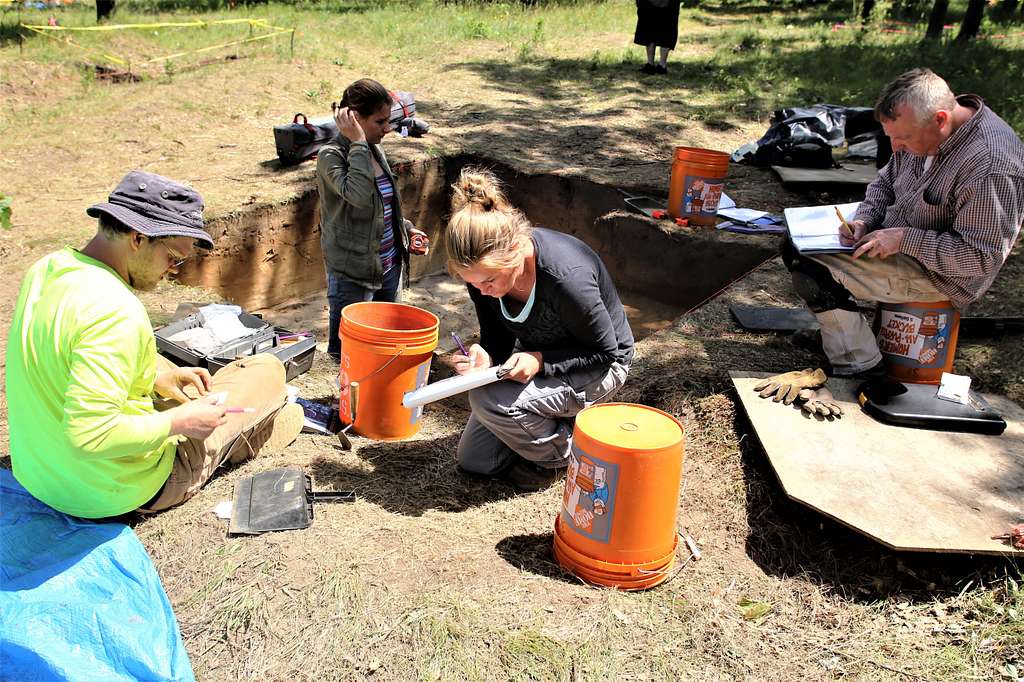
There are also ways to get your hands dirty figuratively and literally by volunteering your time to help heritage and archaeologist professionals. Believe it or not, archaeology in Aotearoa New Zealand has a strong tradition of volunteer or “amateur” involvement. If you develop skills or you bring skills to the table, you may even be a desirable employee!
Unfortunately, there are no official structured volunteer programmes in Aotearoa. The small industry size probably has a lot to do with this. However, that’s not to say there are no opportunities out there.
Volunteer initiatives are project-specific and often driven by poster-worthy, admirable (in my book) champions with a passion for community involvement. Here are a couple of recent projects that have had a strong public engagement arm:
- The 2021 HMS Buffalo Re-examination Project undertook a detailed underwater survey of the HMS Buffalo shipwreck in Whitianga, New Zealand.
- 2017 Mangahawea Bay Partnership Programme between Ngāti Kuta and Patukeha, Te Papa Atawhai/Department of Conservation, University of Otago and Heritage New Zealand Pouhere Taonga. This involved excavations at a place of Polynesian settlement on Moturoa, Ipipiri (Bay of Islands).
More occasionally, individual archaeologists and heritage practitioners may welcome assistance with whatever fascinating tasks they have ahead of them.
If you would like to get involved, I recommend to you, dear reader, to build relationships with your local archaeologist. That being said, please do respect that not all projects are appropriate for public involvement due to ethical considerations, time and funding constraints, or health and safety risks. Be a champ and respect any declines you receive.
Archaeologists can be hesitant at first. Best not to look ’em in the eye. A coffee in hand helps whilst performing a courtship dance. Here are their local habitats:
- The NZAA Membership Consultant Directory includes an interactive map of archaeological consultants in your area.
- Heritage New Zealand Pouhere Taonga has offices around the motu, where public servant archaeologists can be found.
- A few further archaeologists work at Te Papa Atawhai Department of Conservation.
- The main tertiary education archaeology programmes in Aotearoa are Te Whare Wānanga o Ōtāgo University of Otago and Waipapa Taumata Rau University of Auckland (eek, ignore that lost man on the front page 😅). Further specialists also work at some of the other universities around the country.
- Few district and regional councils have archaeologists on the books. The largest crew is within the Auckland Council Heritage Unit.
6. Join the community
The next way to get involved with archaeology is to engage with people already interested in archaeology, heritage, wāhi tupuna, or ancestral places. What are these communities?
The New Zealand Archaeological Association (NZAA) is a not-for-profit, registered charity organisation run by volunteers. Members of NZAA include professionals, amateurs, students, schools, charities and other organisations with an interest in the archaeology of Aotearoa New Zealand.
Benefits of being a NZAA member include:
- Receiving the quarterly Archaeology in New Zealand newsletter.
- Receiving discounted rates at the annual NZAA conference. The conference is the Association’s highlight of the year, where everyone gets together to share research, wānanga (workshop, reflect and discuss) current issues and go on field trips.
- Ability to apply for your site recording project to be funded by the Walton Fund (up to $1,000).
- If you are an archaeological consultant, you can be listed in the consultant’s directory.
NZAA also organises the annual New Zealand Archaeology Week (usually announced on their news page). Who would’ve known we had such a national week! Now you do!
ArchWeek’s purpose is to showcase the importance of archaeology to the public by hosting events across the country, including presentations, field trips, excavation and lab open days, exhibitions and online content. The week is usually in April, so keep an eye out to see what’s going on in your area.
In addition to NZAA, there are a bunch of keen beans and knowledgeable people on the Aotearoa New Zealand Archaeology (ANZARC) Facebook Page. All things archaeology and heritage are shared there, and all non-trolls are welcome.
7. Become one
The final way to engage with archaeology in Aotearoa New Zealand, or anywhere for that matter, is to train to become an archaeologist. The pathways into archaeology deserve their own post, so I won’t go into any detail here. But basically, you can train to become an archaeologist by getting a tertiary qualification through the archaeology programmes of Te Whare Wānanga o Ōtāgo University of Otago or Waipapa Taumata Rau University of Auckland. You can also study overseas too.
Summary
There are many ways to engage with archaeology. I have identified seven key ones, which are mostly free – well, not the tertiary study part! We can dream…
These seven points can be boiled down to researching the archaeology in your area, visiting places (where publicly accessible and appropriate), and engaging with others who are just as keen about the past before us as you! That includes listening to people knowledgeable about the area and its significant places, reaching out to archaeologists to be involved where possible, joining the community online or through NZAA, or training to become an archaeologist yourself.
If you are embarking on your archaeology journey (as a profession or general interest), I hope you feel a bit more informed about how to continue it. If you feel this information has been helpful, please subscribe, like and share it with those who may also benefit.
Feel free to leave comments below. I would love to hear what content you want to read about next.
Zac
 The Past Before Us
3 thoughts on “7 ways to engage with archaeology”